
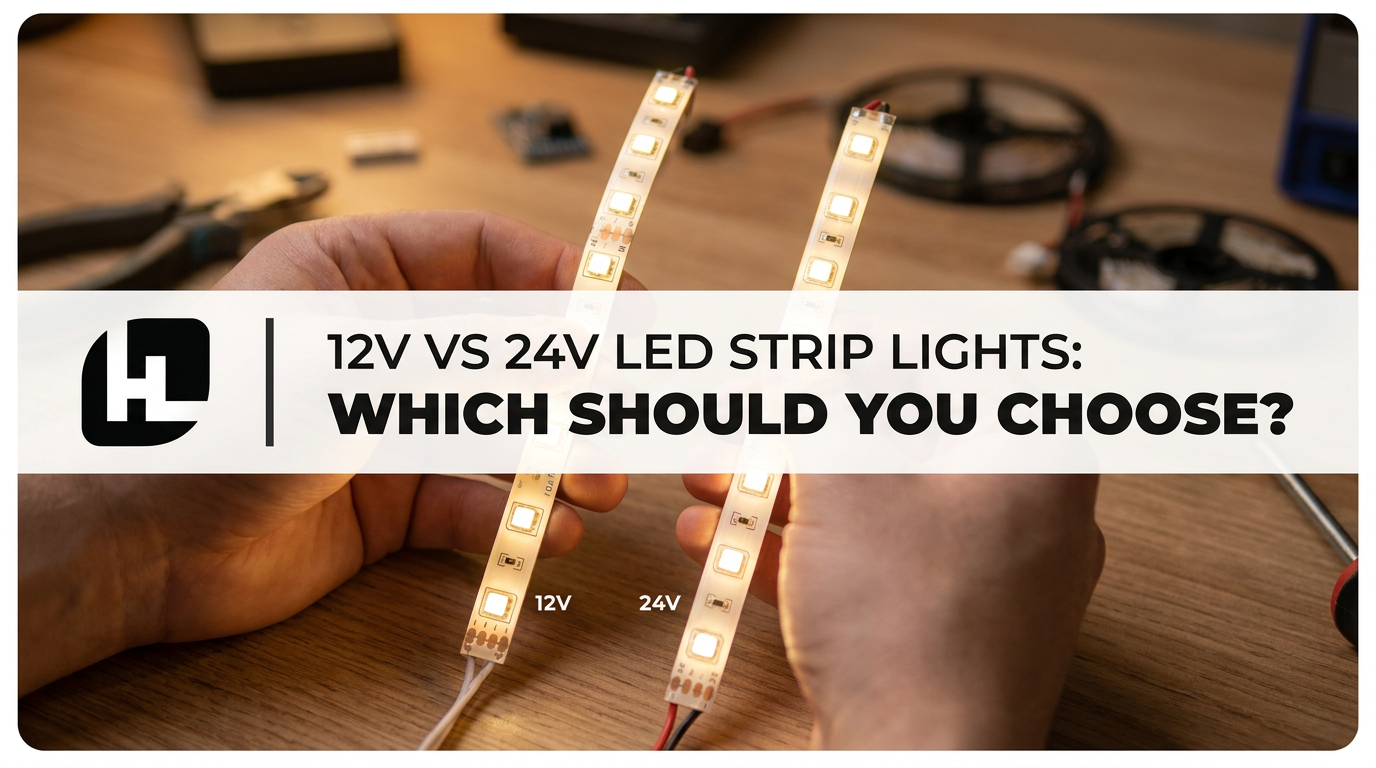
- Why Voltage Matters in LED Strip Installations
- What Is Voltage Drop and Why Does It Matter?
- 12V LED Strip Lights: When to Choose Them
- 24V LED Strip Lights: When to Choose Them
- Side-by-Side Comparison
- Can You Mix 12V and 24V on the Same Project?
- The 20% Power Supply Rule Applies to Both
- What Professional Installers Use
- Frequently Asked Questions
- Shop by Voltage
Walk into any electrical supply house or LED distributor and you'll find LED strips in two primary voltages: 12V and 24V. Both convert low-voltage DC power into light. Both use the same installation process. But choosing the wrong voltage for your run length, your load, or your application will cost you — in voltage drop, in wasted materials, and in callbacks.
This guide covers everything you need to make the right call for your project.
Why Voltage Matters in LED Strip Installations
LED strips are low-voltage DC devices. They require a power supply to convert 120V AC wall power down to either 12V or 24V DC. That conversion is straightforward — but the voltage you choose determines how far your strips can run, how much current they draw, and how well they perform over long distances.
The core physics: for the same wattage, a 24V strip draws half the current of a 12V strip. Lower current means less resistance loss over the length of the run, which translates directly to less voltage drop.
What Is Voltage Drop and Why Does It Matter?
Voltage drop is the reduction in voltage that occurs as current travels through the resistance of the copper traces in your LED strip. The further the current travels from the power supply, the more voltage is lost — and the dimmer the LEDs at the far end of the run appear compared to the LEDs near the source.
With a 12V strip, even moderate run lengths (10–15 feet) can show visible dimming at the far end. With a 24V strip, that same run shows significantly less drop because the current is half as high for the same wattage. This is why experienced installers default to 24V for any run over 15 feet.
12V LED Strip Lights: When to Choose Them
12V is the right choice when:
- Your run is under 10–12 feet and power supply placement is close to the strip
- You're working in a vehicle, RV, boat, or marine application (12V battery systems are standard)
- You need maximum accessory compatibility — the widest range of dimmers, controllers, and connectors are built for 12V
- Budget is the primary concern and you don't need long runs
- You're doing a simple DIY install in a dry indoor location
12V limitations:
- Voltage drop appears faster — visible dimming can occur as early as 10–15 feet from the power supply
- Higher current draw requires heavier gauge wire for long runs
- Not recommended for commercial or multi-zone installations
24V LED Strip Lights: When to Choose Them
24V is the right choice when:
- Your run exceeds 15 feet from the power supply
- You're installing in a commercial, retail, or hospitality environment
- You're doing a cove, soffit, or architectural lighting installation where the entire run must appear uniform
- You're daisy-chaining multiple strips or running multiple zones from one driver
- The power supply needs to be located away from the strip (remote mounting)
- You're specifying for a contractor or integrator project where code compliance and reliability are non-negotiable
24V advantages:
- Half the current draw of 12V for the same wattage = significantly less voltage drop
- Longer run capability without visible dimming
- Preferred for UL Listed commercial-grade installations
- COB LED strips are predominantly available in 24V
Side-by-Side Comparison
| Factor | 12V | 24V |
|---|---|---|
| Max run before visible drop | 10–15 ft | 25–30 ft |
| Current draw (same wattage) | Higher | Half of 12V |
| Accessory compatibility | Widest | Good (growing) |
| Cost | Lower | Slightly higher |
| Best for | DIY, short runs, vehicles | Pro installs, long runs, commercial |
| COB strip availability | Limited | Widest selection |
| UL Listed options | Available | Full range available |
Can You Mix 12V and 24V on the Same Project?
Not on the same circuit — you cannot connect 12V and 24V strips together or run them from the same power supply. They require separate power supplies matched to each strip's voltage. However, you can use both on different zones within the same project, as long as each zone has its own correctly-rated driver.
The 20% Power Supply Rule Applies to Both
Regardless of voltage, always size your power supply at 120% of your total strip wattage. A 32-foot run of a 3W/foot 24V strip = 96 watts total. You need a 120W power supply minimum — not a 100W. This 20% headroom prevents the driver from running at full load continuously, which shortens its lifespan and causes overheating.
For detailed power calculation guidance, see our complete guide on how to cut LED strip lights for sizing your runs, and our wattage calculation post for power supply sizing.
What Professional Installers Use
If you ask any experienced electrician, LED integrator, or cabinet maker what voltage they default to — the answer is almost always 24V. The reasons are practical:
- Longer runs without voltage drop callbacks
- Fewer power injection points needed
- Cleaner installations with less visible wiring
- Better compatibility with professional-grade dimmable drivers
- Most UL listed LED strip lights in the professional tier are 24V
For quick DIY jobs under 10 feet, 12V works fine. For anything else, 24V is the professional standard.
Frequently Asked Questions
Can I run a 24V strip from a 12V power supply?
No. Running a 24V strip from a 12V supply will result in dim output at best and potential damage to the strip. Always match the power supply voltage to the strip voltage.
Is 24V safer than 12V?
Both are low-voltage DC and considered safe for handling. 24V is not inherently dangerous — the low-voltage classification (under 50V DC) applies to both. The risk difference is negligible in standard LED strip applications.
Do dimmers work with both voltages?
Yes — but you must use a dimmer rated for the correct voltage. A 12V dimmer cannot be used with a 24V strip. Always verify voltage compatibility before purchasing a dimmer or controller.
What about 48V LED strips?
48V strips exist and offer even longer runs, but they require specialized drivers and are primarily used in commercial and architectural lighting projects. For standard residential and light commercial work, 24V is the professional sweet spot.
Shop by Voltage
Updated June 2026 | HitLights — Factory-Direct LED Strip Lighting Since 2010