
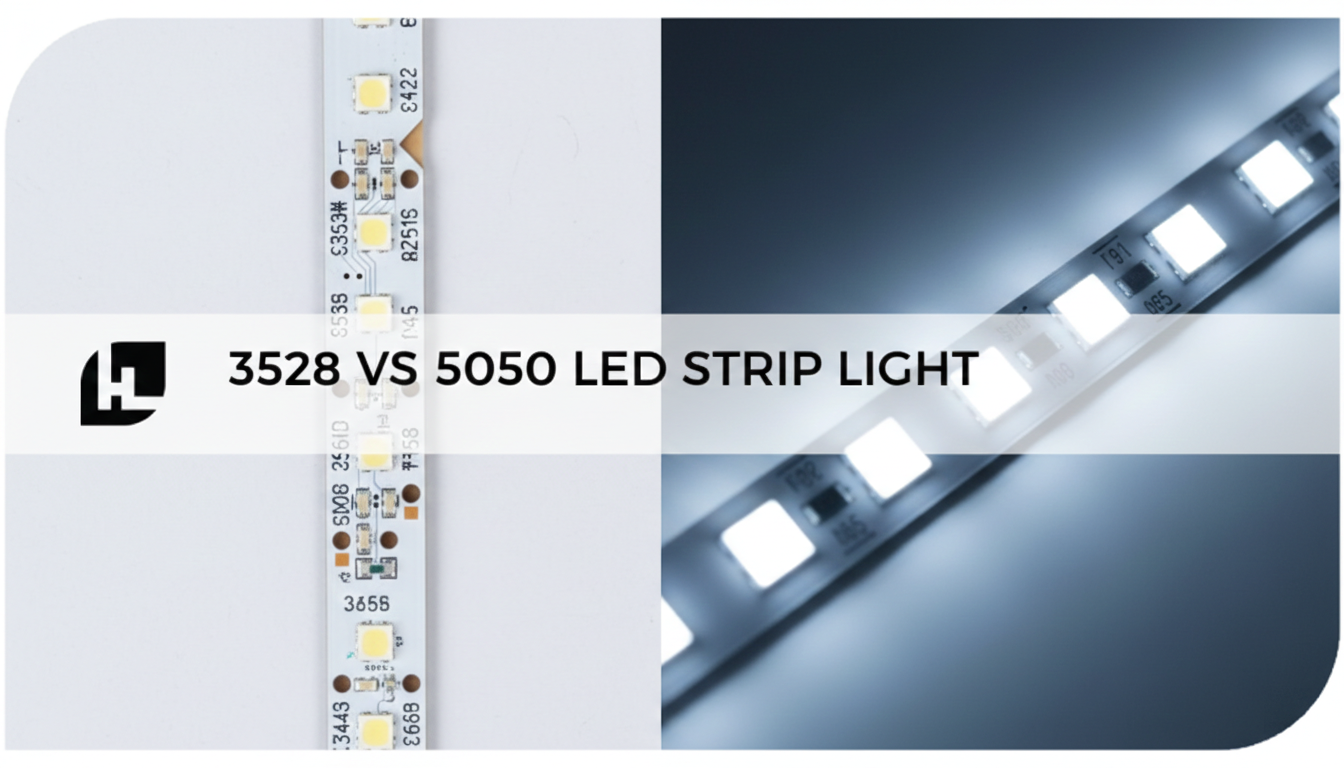
- What “3528” and “5050” Mean (And Why It Matters)
- 3528 vs 5050 Brightness: What You’ll Actually See
- Power, Heat, and Efficiency: The Hidden Difference
- Color Options: When 5050 Is the Clear Winner
- Dotting, Diffusion, and the “Clean Line” Look
- CRI and Light Quality: Crucial for Architectural Projects
- Voltage Drop and Long Runs: 12V vs 24V Reality
- Best Use Cases: 3528 vs 5050 in the Real World
- Common Mistakes (And How to Avoid Them)
- Conclusion: Which Should You Pick?
Choosing between 3528 vs 5050 isn’t just about brightness. It affects how your led strip light performs behind diffusers, how clean the “line of light” looks, how long you can run each circuit, and whether it suits architectural LED strip lighting (coves, reveals, millwork, wall accents, and linear details).
-
Pick 3528 for soft accent lighting, lower power draw, less heat, and budget-friendly ambient glow.
-
Pick 5050 for higher brightness, better punch through diffusion, and stronger RGB/RGBW color effects.
What “3528” and “5050” Mean (And Why It Matters)
These numbers describe the SMD LED package size (surface-mount LED footprint):
-
3528 = about 3.5 mm × 2.8 mm
-
5050 = about 5.0 mm × 5.0 mm
Bigger packages typically support more light output and/or multiple LED dies, which is why 5050 strips often appear brighter and are widely used for RGB.
3528 vs 5050 Brightness: What You’ll Actually See
In most real-world strip designs, 5050 LEDs are commonly brighter per LED than 3528 LEDs. However, brightness depends on the whole strip specification, not just chip size.
When comparing strips, prioritize these metrics:
-
Lumens per meter (lm/m): your best apples-to-apples brightness measure
-
Watts per meter (W/m): power and heat indicator
-
LED density (LEDs/m): affects dotting and smoothness
-
Optics & diffusion setup: determines how “continuous” the light looks
Architectural takeaway: If you need a clean, premium line behind a diffuser, you often want either:
-
a higher LED density, or
-
more channel depth (mixing distance), or
-
enough brightness reserve to use heavier diffusion without looking dim.
Power, Heat, and Efficiency: The Hidden Difference
As a general pattern:
-
3528 strips tend to be lower wattage, which often means less heat and longer runs with fewer voltage-drop headaches.
-
5050 strips tend to be higher wattage, enabling more brightness, but requiring better heat sinking and smarter electrical planning.
For architectural installs, heat matters because it impacts:
-
LED lifespan
-
adhesive reliability
-
long-term color stability
-
consistency across long runs
Best practice: Use an aluminum channel for either type, but especially for higher-output 5050 strips.
Color Options: When 5050 Is the Clear Winner
If you want RGB color-changing, 5050 is often the default choice because many 5050 packages are designed to support multiple diodes (helpful for color mixing).
Choose based on your goal:
-
Single-color white (warm/neutral/cool): 3528 or 5050 can both work; focus on CRI, density, diffusion, and brightness requirement.
-
RGB / RGBW architectural scenes: 5050 is usually better for stronger saturation and output.
-
Premium architectural white: focus on high CRI and consistency first; package size is secondary.
Dotting, Diffusion, and the “Clean Line” Look
For architectural LED strip lighting, one of the most common disappointments is seeing individual LED dots through a diffuser.
Whether you pick 3528 or 5050, the “continuous line” result depends mainly on:
-
LED density (LEDs/m)
-
Channel depth/mixing distance
-
Diffuser type (light frost vs heavy frost)
-
Brightness headroom (so diffusion doesn’t kill output)
How chip size affects this:
-
3528 is often used in higher densities at modest power, which can help reduce dotting.
-
5050 can be bright enough to tolerate heavier diffusion, but if density is low and the channel is shallow, you can still see hotspots.
Rule of thumb: If you’re chasing a “neon-like” line, choose by density + profile depth + diffuser, not by 3528/5050 alone.
CRI and Light Quality: Crucial for Architectural Projects
If you’re lighting interiors where surfaces and people matter, lobbies, retail, residential, restaurants, prioritize:
-
CRI 90+ (common benchmark for better color rendering)
-
consistent color temperature (less variation between reels/batches)
-
stable dimming performance
Important: CRI is not guaranteed by 3528 or 5050. You can find high-CRI and low-CRI options in both.
Architectural spec habit: If it’s a client-facing space, treat CRI and consistency like you would paint color accuracy—non-negotiable.
Voltage Drop and Long Runs: 12V vs 24V Reality
For longer runs, voltage drop causes dimming toward the end of the strip. This becomes more noticeable as power increases.
General guidance:
-
24V systems usually handle longer runs better than 12V systems.
-
High-output strips (often 5050-based) typically need power injection sooner
-
Use an appropriate wire gauge and avoid overloading a single feed
Practical takeaway: If your design uses long continuous lines in coves or reveals, plan power like an architectural system:
-
segment runs
-
inject power at intervals
-
keep driver headroom
Best Use Cases: 3528 vs 5050 in the Real World
Choose 3528 for:
-
subtle ambient coves and soft ceiling glow
-
toe-kick, under-bed, hallway guidance lighting
-
shelves and niches where the light should feel gentle
-
projects that prioritize efficiency, lower heat, and cost control
Ideal vibe: “quiet luxury” glow and background ambiance.
Choose 5050 for:
-
Brighter coves and features that must be read clearly
-
Installations behind heavier diffusion need more output
-
RGB/RGBW scenes (hospitality, bars, feature walls)
-
Accents where you want a stronger visual impact
Ideal vibe: bold lines, stronger bounce lighting, and dynamic color.
Common Mistakes (And How to Avoid Them)
-
Choosing by chip size instead of strip specs
Always compare lm/m, W/m, LEDs/m, CRI, voltage, and channel/diffuser. -
Underestimating diffusion needs
A great architectural finish usually requires proper mixing distance or higher density. -
Undersizing the driver
Add headroom so the system runs cooler and more stable (common practice is ~20–25% headroom). -
Ignoring heat management
Especially with higher-output strips, use aluminum channels and avoid trapping heat in tight cavities. -
Skipping electrical planning for long runs
Voltage drop is a design issue, not a “product defect.” Plan feeds and injection.
Conclusion: Which Should You Pick?
If you want efficient, subtle, and clean ambient accents, 3528 is often the smarter, simpler choice.
If you need more brightness, stronger diffusion performance, or RGB/RGBW effects, 5050 is typically the better fit.
For architectural led strip lighting, the best results come from specifying the entire system: brightness target (lm/m), LED density, CRI, voltage, channel depth, diffuser type, thermal management, and power distribution.