
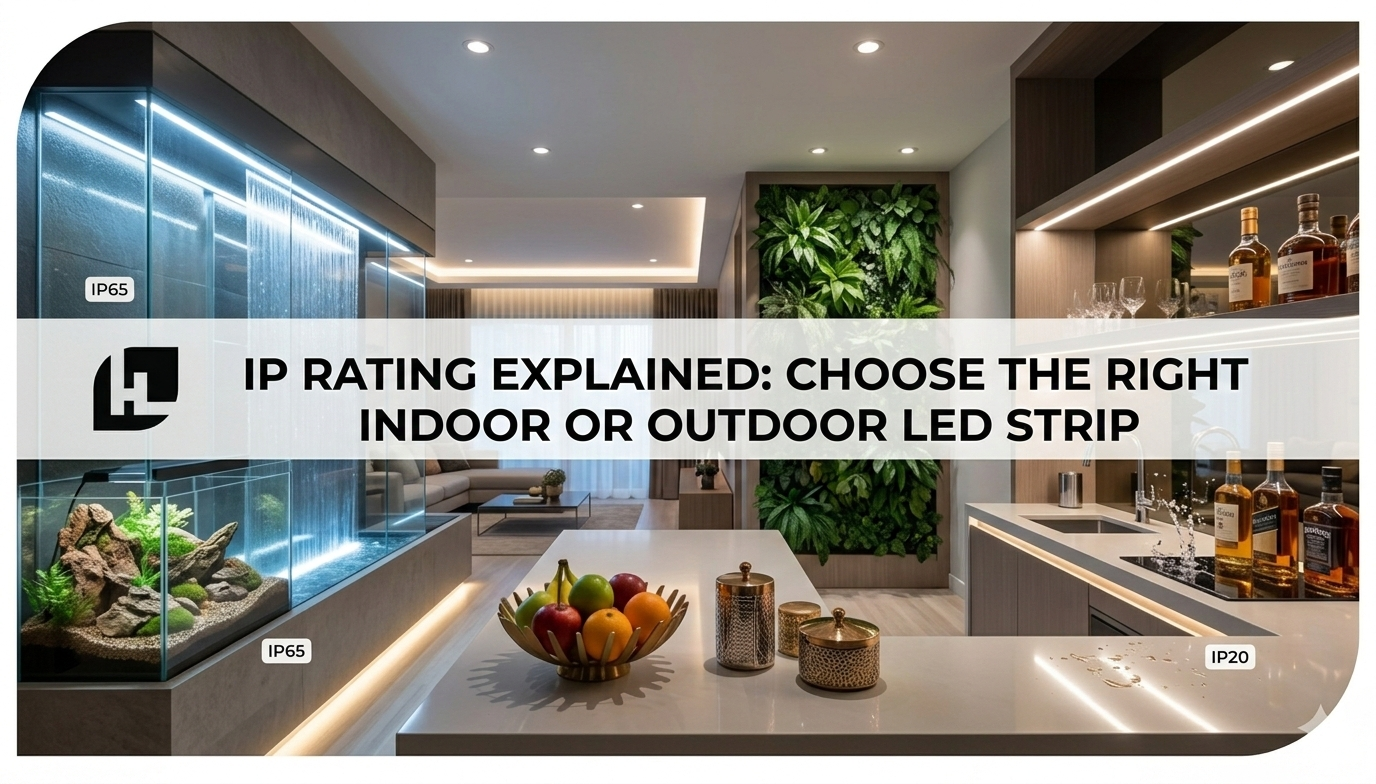
- What “IP Rating” Means (and Why It Matters for LED Strips)
- How to Read the IP Code: The “IP” + Two Digits
- The First Number (Solids): What 0–6 Means
- The Second Number (Water): What 0–9 Means
- Common LED Strip IP Ratings (and What They Usually Mean in Real Life)
- How to Choose the Right IP Rating for Indoor vs Outdoor LED Strip
- “Commercial Grade Outdoor LED Strip Lights”: What to Look For Beyond IP Rating
- The Most Common IP Rating Mistakes (LED Strip Edition)
- IP vs NEMA: Should You Care?
- LED Strip IP Rating Cheat Sheet (Fast Recommendations)
- Conclusion
If you’re shopping for an indoor LED strip or an outdoor LED strip, the “IP rating” is one of the fastest ways to predict how well the product will survive dust, splashes, rain, or full-on immersion. But IP labels also get abused in marketing, so understanding what the numbers in an IP rating actually mean helps you buy the right strip the first time.
Below is a practical, LED-strip-focused guide to IP rating basics, what each digit means, and how to choose the right protection level for bedrooms, kitchens, patios, storefronts, and commercial grade outdoor led strip lights installations.
What “IP Rating” Means (and Why It Matters for LED Strips)
IP stands for Ingress Protection—a standardized code defined under IEC 60529 that describes how well an enclosure resists intrusion from solid objects (dust, fingers, debris) and liquids (water exposure).
For LED strip lights, IP rating usually reflects how the strip is sealed (bare PCB, silicone coating, silicone sleeve/tube, fully potted, etc.). The higher the protection, the better it handles harsh environments, but often with tradeoffs (heat dissipation, brightness, flexibility, and cost).
How to Read the IP Code: The “IP” + Two Digits
Most products show: IP + two digits (example: IP65).
-
First digit (0–6): protection against solids (dust/particles + access to hazardous parts)
-
Second digit (0–9): protection against water (drips, splashes, jets, immersion, high-temp jets)
Sometimes you’ll see:
-
IPX5 (unknown/not tested for solids; tested for water to level 5)
-
IP6X (tested for solids to level 6; water not specified)
-
Extra letters exist, but are uncommon for consumer LED strips.
The First Number (Solids): What 0–6 Means
Think of the first digit as “dust and debris resistance” and also “how easy it is for fingers/tools to reach live parts.”
|
First digit |
Meaning (solids) |
Plain-English takeaway for LED strips |
|
0 |
No protection |
Bare exposure; avoid unless fully protected by another enclosure |
|
1 |
>50 mm objects |
Minimal; not typical for strips |
|
2 |
>12.5 mm (finger) |
Basic protection; still not dust-resistant |
|
3 |
>2.5 mm (tools, thick wires) |
Better, still not dust-resistant |
|
4 |
>1 mm (most wires, small objects) |
Good against small debris, not dust-proof |
|
5 |
Dust protected |
Dust can enter, but not enough to harm the operation |
|
6 |
Dust-tight |
No dust ingress under test conditions |
Practical note: For an outdoor LED strip, dust matters more than many people think. Wind-blown grit, pollen, and fine construction dust can work into unsealed channels and connectors over time. IP6X (the “6” in IP67/IP68) is a strong signal you’re in the right category for outdoors.
The Second Number (Water): What 0–9 Means
The second digit is the big one for indoor LED strip vs outdoor LED strip decisions. It indicates resistance to water exposure types such as dripping, splashing, jets, and immersion.
|
Second digit |
Water protection |
Where it fits for LED strips |
|
0 |
None |
Dry, protected indoor only |
|
1–2 |
Drips (vertical/slight angle) |
Rare for strips; not “kitchen-safe” by default |
|
3–4 |
Spray/splashes |
Useful near sinks if installed well |
|
5 |
Water jets |
Better for exposed outdoor areas (not pressure washing) |
|
6 |
Powerful water jets |
Harsh rain, heavy spray zones |
|
7 |
Temporary immersion (commonly referenced as 1m/30min in many summaries) |
Good for “could get submerged briefly” scenarios |
|
8 |
Continuous immersion (manufacturer-defined conditions) |
Potted/submersible designs (verify spec details) |
|
9 |
High-pressure, high-temperature water jets (washdown) |
Industrial cleaning zones; specialized fixtures |
Quick translation
-
IP44: splash-resistant (good for some damp indoor locations)
-
IP65: rain-resistant / jet-resistant (common “outdoor” rating)
-
IP67: can handle temporary immersion (usually achieved with tighter sealing)
-
IP68: “continuous immersion,” but always check the fine print
Common LED Strip IP Ratings (and What They Usually Mean in Real Life)
IP20 (Typical Indoor LED Strip)
-
IP20 usually means: protected from finger contact to some degree, no water protection.
-
Best for: bedrooms, living rooms, behind TVs, ceilings in dry areas.
If you’re choosing an indoor LED strip for ambiance (cove lighting, shelves, behind monitors), IP20 is often perfect, as long as it won’t see splashes or steam.
IP44 (Damp-Location Friendly Indoor Use)
-
Often used for: bathrooms (outside direct spray), under-cabinet lighting away from sink spray, laundry rooms.
-
Still not a license to soak it, think splashes, not streams.
IP65 (The Workhorse Outdoor Rating)
-
Very common for “outdoor LED strip” listings.
-
Usually built with a silicone coating or sleeve that resists rain and water jets.
Best for:
-
under eaves and soffits
-
patios/pergolas
-
exterior accent lines on walls
-
signage borders (with proper channels and sealed ends)
IP67 (Outdoor + “Accidental Immersion” Protection)
-
Often indicates stronger sealing than IP65, sometimes a fully sleeved strip with sealed ends.
-
Better for: ground-level installs, areas where puddling could occur, or where the strip might get briefly submerged during storms.
IP68 (Continuous Immersion, But Verify the Spec)
-
IP68 is not one universal test depth/time; the immersion conditions are typically specified by the manufacturer for the product.
Used for: -
fountains, pools, marine accents, and specialty outdoor builds
Important: Many “IP68 LED strips” are the strip only. Connectors, power injection points, controllers, and power supplies may not match that rating. The system is only as waterproof as the weakest entry point.
How to Choose the Right IP Rating for Indoor vs Outdoor LED Strip
For an indoor LED strip (dry areas)
Choose IP20 if:
-
It’s in a bedroom/living room/office
-
It’s installed in a profile/channel away from moisture
-
You care about maximum flexibility and heat dissipation
Choose IP44 if:
-
It’s near occasional humidity or light splashes (e.g., under cabinets, some bathroom zones)
-
You want a little extra protection without going “fully outdoor.”
For an outdoor LED strip (typical home exterior)
Choose IP65 if:
-
The strip is under some protection (eaves/pergola), but still exposed to wind-driven rain
-
You can install it in a channel and properly seal ends and connections
Choose IP67 if:
-
The strip is low to the ground
-
It’s on steps, retaining walls, garden borders, or places where water can pool
-
You want a bigger safety margin against storms
Choose IP68 only if:
-
You truly need continuous immersion resistance and
-
The listing provides actual immersion conditions (depth/time) and system-level waterproofing details
“Commercial Grade Outdoor LED Strip Lights”: What to Look For Beyond IP Rating
The keyword “commercial grade outdoor LED strip lights” often implies more than just water resistance. IP rating tells you ingress protection, not whether the product is built for long, demanding duty cycles.
For commercial-grade expectations, look for:
-
Higher IP + better sealing quality (consistent end caps, molded leads, properly potted injection points)
-
UV resistance (sunlight can yellow/embrittle cheap silicone sleeves over time)
-
Thermal management (outdoor sealing can trap heat; aluminum channels help a lot)
-
Voltage drop planning (long runs need power injection; every injection point must be sealed)
-
Compatible accessories: waterproof connectors, waterproof controller housing, outdoor-rated power supply placement (often in an enclosure)
IP code covers ingress, not corrosion resistance, UV aging, or installation quality.
The Most Common IP Rating Mistakes (LED Strip Edition)
Mistake 1: Assuming “IP65 strip” = fully waterproof system
Reality: the strip might be IP65, but your:
-
solder joints
-
snap connectors
-
controller box
-
power supply
…may be far less protected.
Mistake 2: Not sealing cut ends
Most strips are cut-to-length. Each cut creates an “open wound.” For outdoor installs, you typically need:
-
end caps
-
silicone sealant/adhesive
-
heat shrink or potting (depending on design)
Mistake 3: Choosing a higher IP without considering heat
Waterproof coatings can reduce airflow. LEDs run hotter, which can shorten their lifespan and reduce brightness over time. Channels (especially aluminum) help offset this.
Mistake 4: Treating IP68 as universal
IP68 immersion requirements can vary by manufacturer and product design. If the listing doesn’t state immersion conditions, treat “IP68” as incomplete information.
IP vs NEMA: Should You Care?
If you’re doing industrial or North America-centric projects, you may see NEMA enclosure ratings. IP and NEMA are not 1:1 convertible because NEMA can include additional considerations beyond ingress (like corrosion and other environmental factors).
For most LED strip buyers, IP is the primary filter, but commercial installs often use enclosures and power supplies specified by NEMA type as well.
LED Strip IP Rating Cheat Sheet (Fast Recommendations)
-
Bedroom/living room: IP20
-
Under-cabinet (away from sink): IP20 or IP44
-
Kitchen near sink / humid zones: IP44 (or better with good installation)
-
Covered patio/soffit lighting: IP65
-
Fence lines/garden borders/steps: IP67
-
Pool / fountain / constant water contact: IP68 (verify immersion spec + waterproof system components)
Conclusion
An IP rating is a two-digit shorthand that tells you how well a product resists solids (first number) and water (second number) under standardized testing. For LED strips, the sweet spot is usually:
-
IP20 for dry indoor ambiance
-
IP65 for most outdoor accent lighting
-
IP67/IP68 when you expect pooling water, immersion risk, or true wet-environment installs
But the best results come from treating IP as a system requirement: strip + connectors + end seals + channels + controller housing + power supply placement.