
- The Visual Comparison, Briefly
- A Quick Refresher on Chip Numbering
- Cost Per Foot at Volume
- A Worked Comparison: 15-Location Retail Rollout
- Lead Time and Minimum Order Quantities
- When the COB Premium Is Worth Paying at Scale
- When SMD Is the Right Call at Scale
- Quality Consistency Across a Large Order
- A Practical Framework for the Buying Decision
- Hospitality Procurement: A Closer Look
- Shipping and Logistics Considerations at Bulk Scale
- Documenting the Spec for Repeat Orders
- Negotiating Volume Pricing
- Why Chip Type Decisions Shouldn't Be Made in Isolation From the Driver Spec
- Frequently Asked Questions
A facilities manager speccing lighting for one kitchen asks "COB or SMD?" and gets an answer in five minutes by looking at a product photo. A contractor or purchasing manager sourcing strip for 40 units, a hotel renovation, or a multi-site retail rollout is asking a different question entirely — one that existing comparison content almost never addresses: which chip type actually makes sense once cost per foot, lead time, and minimum order quantities enter the decision.
This guide is written for that second buyer — the one deciding a chip type for dozens or hundreds of units at once, where a small per-foot difference compounds into a real line item, and where lead time and batch consistency matter as much as the visual comparison a single-room buyer can settle with a product photo.
The Visual Comparison, Briefly
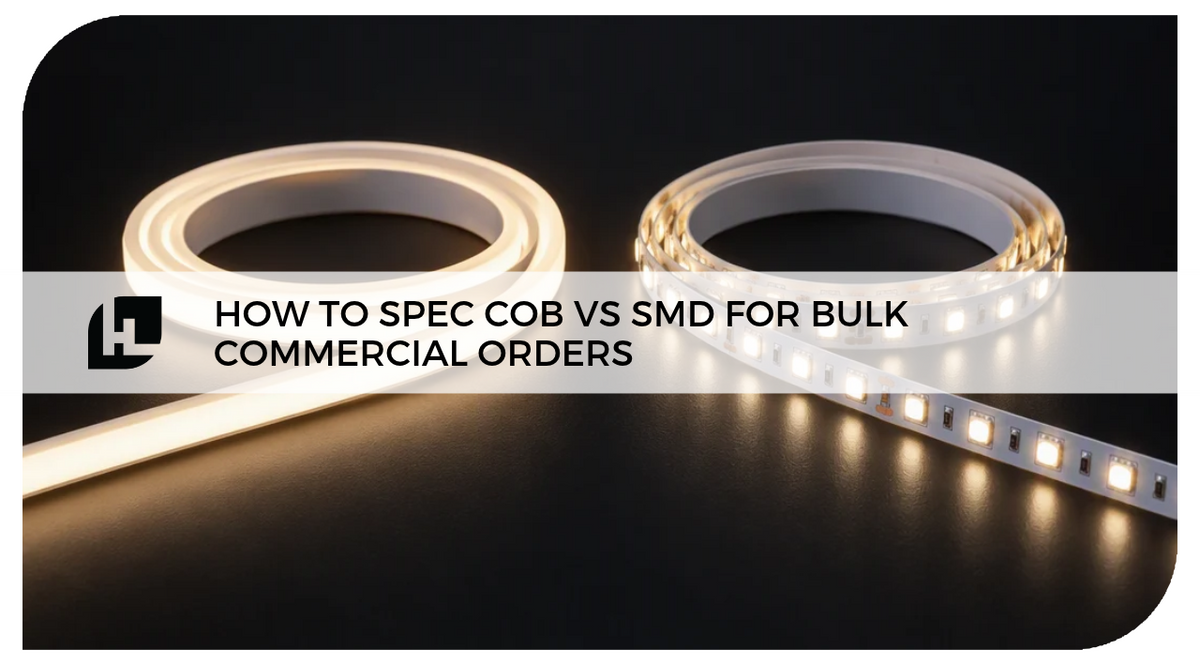
COB (Chip-on-Board) strips use a continuous phosphor coating over densely packed LED chips, producing a smooth, dot-free light output with no visible individual points of light. SMD (Surface-Mounted Device) strips use individually visible LED chips spaced along the strip, which can show distinct points of light, especially at lower densities or closer viewing distances. Our deeper explainers on what COB lighting actually is and whether COB is genuinely "better" than standard LED strip cover the visual and technical distinction in more depth than this guide needs to repeat.
For a single install, this is largely an aesthetic choice. At bulk-order scale, it becomes a cost and logistics decision as much as a visual one.
A Quick Refresher on Chip Numbering
Bulk buyers sourcing SMD product will also run into chip-size numbering — 2835, 3528, 5050, and similar designations referring to the physical dimensions of the LED package in tenths of a millimeter. Our reference guide on what these LED numbers actually mean is worth bookmarking for your procurement team, since suppliers will reference these numbers directly in quotes and spec sheets, and a purchasing manager who can read them independently moves through supplier conversations faster. The short version for a bulk buying decision: larger chip packages (5050) generally produce more lumens per chip at a given current, while smaller packages (2835, 3528) allow higher density per foot for a smoother, more uniform look at standard viewing distances. A related comparison on the specific differences between SMD 3528 and SMD 5050 digs further into this if your bulk order is comparing within the SMD category rather than between SMD and COB.
Cost Per Foot at Volume
SMD strips are generally the lower-cost option per linear foot, and that gap often widens — not narrows — at bulk order volumes, because SMD production lines are more standardized across the industry and command pricing benefits from broader supplier competition. COB strips carry a cost premium tied to the more specialized manufacturing process for the continuous phosphor coating.
For a large order — say, outfitting 30 hotel rooms or 15 retail locations with identical cabinet or cove lighting — that per-foot cost difference compounds quickly. Run the total linear footage across the full project before deciding on chip type; a $0.40/ft premium that looks trivial on a single-room estimate becomes a meaningful line item across a multi-site rollout.
A Worked Comparison: 15-Location Retail Rollout
Consider a retail chain outfitting 15 locations with identical under-shelf display lighting, each location requiring roughly 80 linear feet of strip. At 1,200 total linear feet across the project, even a modest per-foot cost difference between COB and SMD becomes a five-figure swing in the total materials line, before labor or shipping are factored in.
If every location is close-viewing-distance retail display where product presentation quality directly affects sales — the kind of environment where COB's dot-free output earns its premium — the calculation may still favor COB despite the higher per-foot cost, because the visual quality improvement has a measurable effect on the business outcome the lighting exists to support. If the application is closer to general aisle or stockroom illumination where customers rarely view the strip up close, SMD's cost advantage usually wins without a meaningful visual tradeoff.
The point isn't that one chip type is universally right for bulk orders — it's that the decision should follow from the actual viewing context and business purpose of each install, calculated at full project scale rather than extrapolated from a single-unit sample. A useful discipline for any procurement team facing this decision: walk the actual floor plan or room layout before finalizing the spec, physically marking which zones are genuinely close-viewing and which aren't, rather than making the call from a drawing alone.
Lead Time and Minimum Order Quantities
This is the factor bulk buyers consistently underweight. COB strips, because of their more specialized production process, often carry longer lead times and higher minimum order quantities from manufacturers than standard SMD product. If your project has a hard installation deadline — a hotel opening date, a retail rollout tied to a seasonal launch — confirm actual current lead time on COB product before committing to it in the spec, not after the order is placed.
For buyers working with a factory-direct supplier like HitLights, lead time and MOQ questions should be part of the initial spec conversation, not a surprise discovered during fulfillment. It's worth asking specifically whether a quoted lead time assumes stock availability or a new production run — the difference between those two scenarios can be weeks, and a quote that doesn't specify which one it's based on should be clarified before it's used to plan an installation schedule. It's also reasonable to ask a supplier directly how their current lead times compare to the same quarter the previous year — manufacturing capacity and raw material availability both shift over time, and a lead time that was accurate six months ago isn't guaranteed to still hold.
When the COB Premium Is Worth Paying at Scale
COB strip's dot-free output is a genuine functional advantage in specific commercial contexts, and in those contexts the premium is justified even at volume:
- Close-viewing-distance applications — under-cabinet lighting, retail display shelving, or any install where customers or guests will be within a few feet of the strip and visible LED dots would be noticeable
- High-CRI commercial applications — COB strips commonly pair with higher CRI ratings, relevant for hospitality, retail, and food-service environments where color accuracy affects the customer experience
- Brand-sensitive installs — hospitality and retail brands with strict design standards often specify COB precisely because dot-free output reads as a more premium finish
When SMD Is the Right Call at Scale
- Long runs where brightness and coverage matter more than close-up dot visibility — warehouse aisles, perimeter lighting, back-of-house areas
- Budget-sensitive multi-site rollouts where the cumulative cost difference across dozens of locations outweighs the aesthetic benefit of COB
- Projects with compressed timelines where SMD's typically shorter lead times and lower MOQs reduce fulfillment risk
Quality Consistency Across a Large Order
A detail that matters more at bulk scale than on a single install: confirm whether the full order quantity will ship from a single production run or across multiple batches. LED chips — both COB and SMD — can show slight CCT or output variation batch to batch even within the same labeled spec. For a 15-location rollout where every site needs to look identical, this is worth asking about explicitly rather than assuming consistency, especially if the order is large enough that it might span more than one production cycle to fulfill.
A Practical Framework for the Buying Decision
- Calculate total linear footage across the entire project, not per unit — this is what cost differences actually scale against.
- Confirm current lead time and MOQ for both chip types directly with your supplier before finalizing the spec — don't rely on general industry assumptions, as these shift with supplier capacity.
- Identify which zones are close-viewing-distance (where COB's dot-free advantage matters) versus which are longer-throw or back-of-house (where SMD's cost advantage dominates).
- Consider a mixed spec — many commercial projects use COB in guest-facing, close-viewing zones and SMD in back-of-house or longer runs, optimizing cost without sacrificing the visual standard where it's visible.
- Confirm batch consistency for any order large enough that it might fulfill across multiple production runs.
Hospitality Procurement: A Closer Look
Hotel and hospitality renovations are one of the most common contexts for this exact bulk decision, and they illustrate the tradeoffs well. A hotel renovating guest room cabinet and vanity lighting across 150 rooms typically faces three competing pressures: a brand standard that may specify a minimum CRI or visual quality bar, a fixed renovation budget that makes per-foot cost differences add up fast across 150 units, and a hard reopening date that makes lead time a real constraint rather than a theoretical one.
In this context, COB is frequently justified specifically in guest-facing zones — vanity lighting, headboard accents — where a guest's perception of room quality directly affects brand reviews and repeat bookings. Back-of-house areas within the same renovation — staff corridors, storage, mechanical rooms — rarely need the same visual standard, making them reasonable candidates for SMD without any guest-facing tradeoff. This is exactly the kind of mixed-spec approach that lets a hospitality renovation hit its visual brand standard in the areas that matter without inflating the total materials cost across every single linear foot in the building.
Shipping and Logistics Considerations at Bulk Scale
Beyond unit cost and lead time, bulk orders introduce logistics questions that don't exist at single-unit scale. Confirm with your supplier how a large order ships — as one consolidated shipment or staged across multiple deliveries — and whether staged delivery aligns with your actual installation schedule across multiple sites or phases of a single large project.
For multi-site rollouts specifically, it's worth asking whether a supplier can ship pre-allocated quantities directly to each site rather than requiring a central receiving point to break down and redistribute one large shipment. This single logistics detail can meaningfully reduce the internal coordination burden on a facilities or procurement team managing a rollout across a dozen or more locations.
Documenting the Spec for Repeat Orders
Multi-site rollouts rarely happen in a single purchase order — a retail chain might renovate 15 locations this year and another 20 next year. Document the finalized chip type, density, CCT, and supplier part number clearly enough that a future order references the exact same spec rather than requiring the comparison process to be repeated from scratch. This also protects against a subtle but real risk: a future buyer on the same team unknowingly specifying a visually different chip type for a later phase of what should be one consistent rollout.
A simple internal spec sheet — supplier name, exact product SKU, chip type, density, voltage, CCT, and the date and order quantity of the original purchase — takes a purchasing team perhaps twenty minutes to put together after the first phase of a rollout closes, and can save hours of back-and-forth confirming details when phase two is ready to order a year later. It also gives a new team member joining the project mid-rollout a single reference document instead of needing to reconstruct the original decision from old email threads or invoices.
Negotiating Volume Pricing
Bulk LED strip pricing is rarely a flat per-foot rate regardless of quantity — most suppliers, including factory-direct manufacturers, offer tiered pricing that improves as total order volume increases. Understanding where those tiers sit before finalizing a spec can materially change the COB-versus-SMD cost comparison.
A practical approach: request pricing at your actual anticipated total project volume, not a smaller sample quantity, since the per-foot rate at 200 feet can look very different from the per-foot rate at 2,000 feet. If a project's full scope isn't locked in yet — for example, a retail chain planning 15 locations this year with another 20 likely next year — it's worth asking a supplier whether committing to the larger total volume upfront, even across multiple delivery phases, unlocks better pricing than treating each phase as a separate, smaller order.
This is also where the COB premium can shrink meaningfully at true bulk scale: if a supplier's COB pricing tier at high volume narrows the gap with SMD pricing at a lower volume tier, the visual quality argument for COB becomes easier to justify across the whole project rather than just in guest-facing zones.
Why Chip Type Decisions Shouldn't Be Made in Isolation From the Driver Spec
COB and SMD strips often have different wattage-per-foot profiles even within comparable brightness and CCT specifications, which means the chip type decision has a downstream effect on driver sizing and, at bulk scale, on the total driver line item across a multi-site project. Before finalizing a bulk chip type decision, confirm the actual wattage draw of the specific product under consideration and re-run the power supply calculation across the full project scope — a chip type that looks like the better buy on strip cost alone can lose some of that advantage if it requires meaningfully more driver capacity across dozens of installed units.
Frequently Asked Questions
Is COB always more expensive than SMD at bulk volume?
Generally yes on a per-foot basis, and the gap typically persists or widens at volume rather than closing, since SMD production is more standardized industry-wide. The decision should weigh that premium against the visual benefit in each specific application rather than assuming SMD is always the better value.
Can I mix COB and SMD strips within the same bulk order?
Yes, and it's a common and often cost-effective approach — many large commercial projects specify COB for guest-facing or close-viewing zones and SMD for back-of-house or long-throw areas within the same overall project.
How far in advance should I confirm lead time for a large COB order?
As early as possible in project planning, and well before a hard installation deadline is locked in — COB lead times are more variable than SMD and more sensitive to whether your order requires a dedicated production run versus pulling from existing stock.
Does committing to a larger total volume across multiple project phases actually improve pricing?
Often yes, if the supplier is willing to quote against the full anticipated volume rather than treating each phase as an independent order. It's worth asking this question explicitly rather than assuming phased orders automatically forfeit volume pricing.
Should driver cost be part of the COB vs. SMD comparison, or just the strip cost?
It should be part of the comparison. Different wattage-per-foot profiles between chip types can shift total driver costs across a large project meaningfully enough to affect which option is actually cheaper once the full bill of materials is calculated, not just the strip line item.
Is it reasonable to request physical samples of both chip types before committing to a bulk order?
Yes, and most factory-direct suppliers can accommodate a reasonable sample request for a project of meaningful size. Comparing physical samples under the actual install location's lighting conditions is a worthwhile final check before a large purchase order, especially for brand-sensitive guest-facing zones.
Request Bulk Pricing on COB and SMD LED Strips
Factory-direct lead times and volume pricing for multi-site and bulk commercial orders. Apply for a trade account to get a quote scaled to your project's actual total footage.