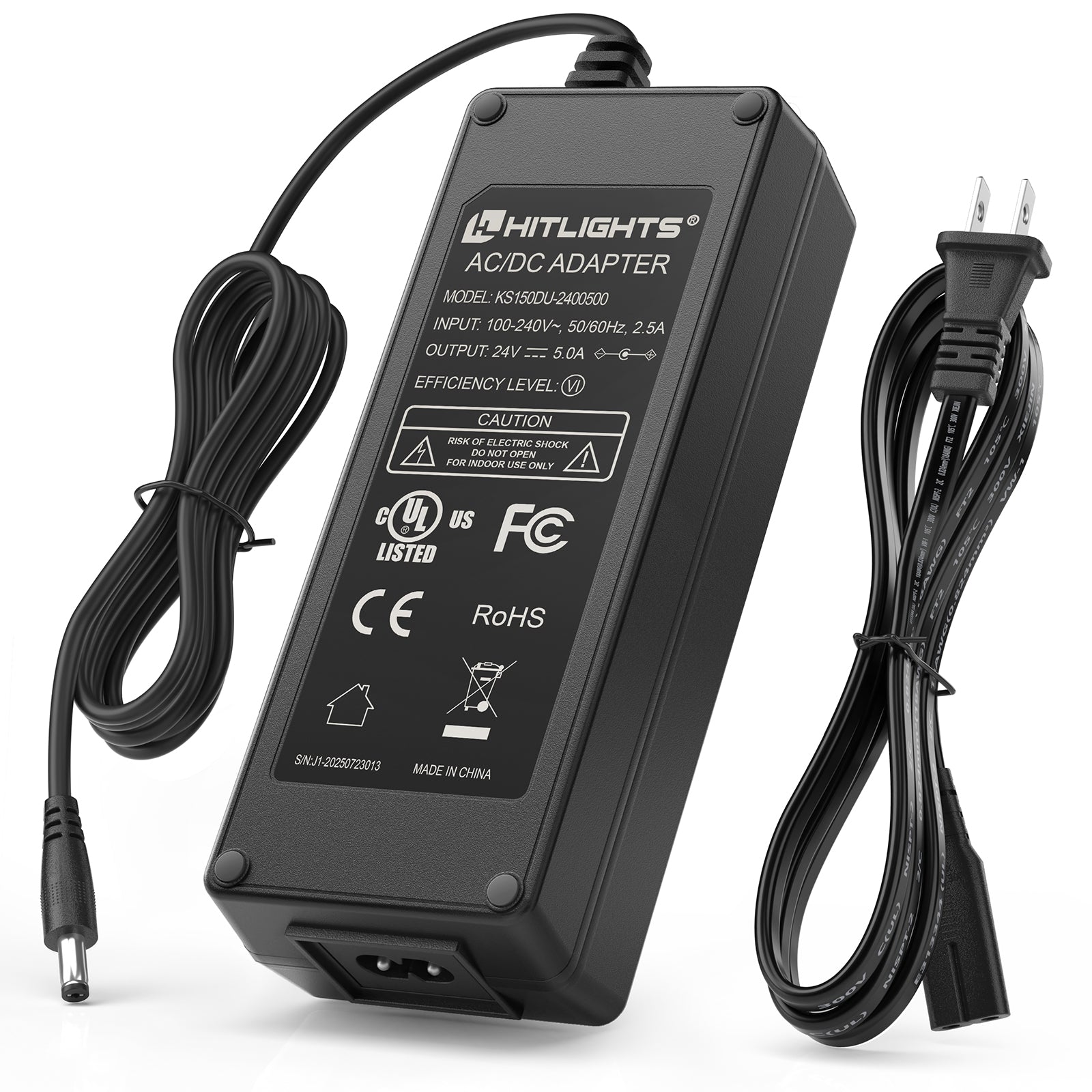
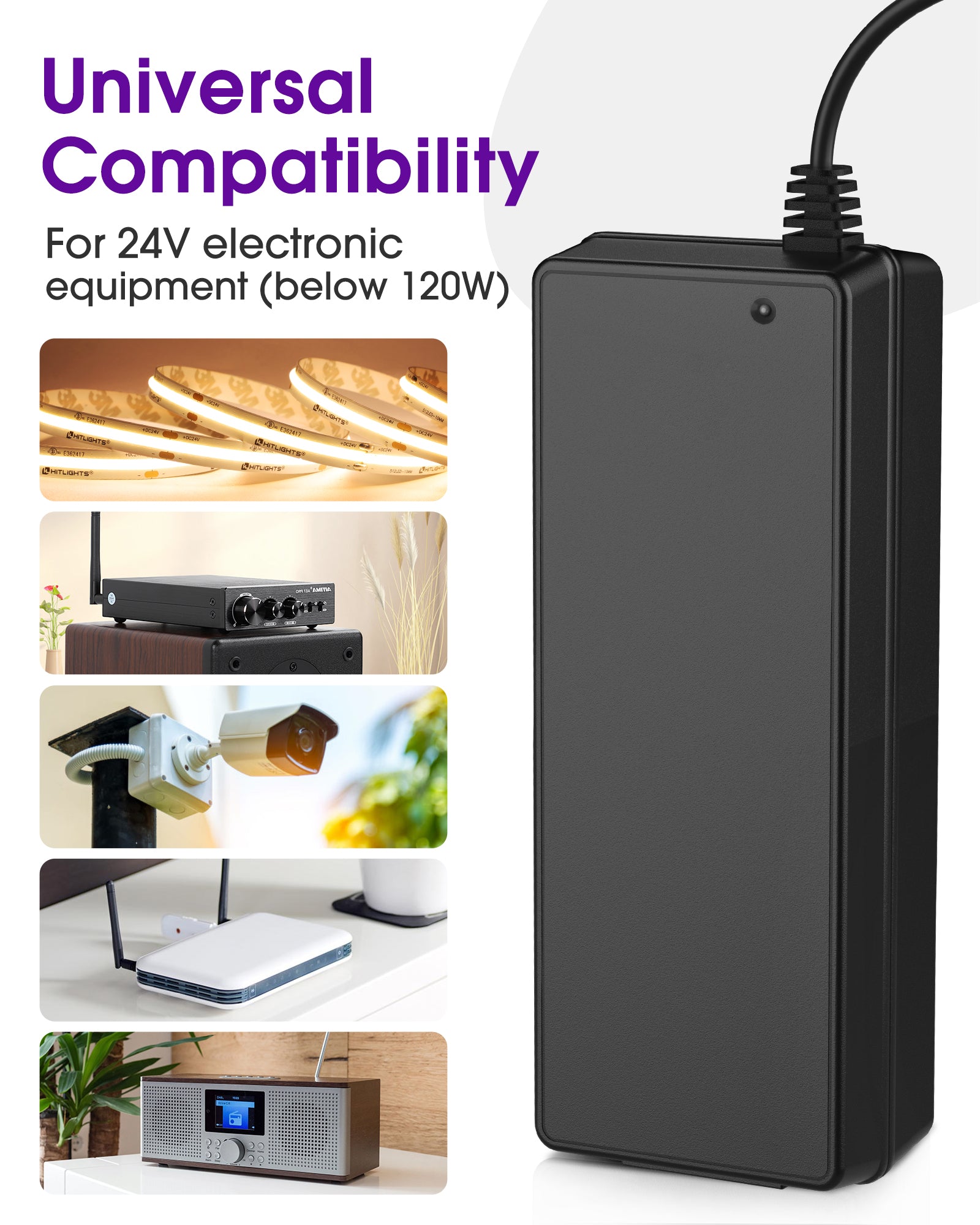
The 24V 120W power supply adapter from HitLights is a UL-listed plug-in driver that converts 110–240V AC to stable 24V DC for LED strip lights and other low-voltage devices. Designed for installers and DIY users, it delivers up to 120 watts (5 amps) through a standard 5.5 x 2.1 mm DC barrel jack.
- 120W output powers a full 24V LED strip run or multiple devices.
- Compact plug-in design enables true plug and play installation.
- UL listing, overload and short-circuit protection improve safety and reliability.
- 3-year warranty supports long-term lighting installations.
The adapter accepts 110–240V AC input on a standard North American NEMA 1 plug and outputs regulated 24V DC up to 120W, suitable for 24V LED strip lights, LED controllers, CCTV cameras, routers, mini amplifiers, and other low-voltage electronics. A 1.2 m DC cable and 1.8 m AC cord provide flexible placement between the outlet and the load.
Built-in protection against short circuit, over-current, over-voltage, and over-temperature helps protect both the power supply and connected devices. The enclosure is rated IP30 for indoor use and sized at approximately 6.5 x 2.75 x 1.5 inches (165.1 x 69.85 x 38.1 mm), making it easy to hide behind cabinets, displays, or entertainment centers.
Unlike generic laptop adapters, this 24V 120W supply is specified for LED strip lighting loads and is compatible with single-color and RGB/RGBW 24V LED strips when paired with an appropriate controller or PWM dimmer. It is non-dimmable on the AC side but works with 24V PWM dimmers and LED controllers to adjust brightness or effects on the DC side.
Typical applications include living room accent lighting, under-cabinet task lighting, small retail displays, office cove lighting, and general indoor 24V DC power needs. With UL certification, indoor-rated design, and a 3-year warranty, this adapter offers a dependable power solution for 24V LED projects and other compatible low-voltage systems.
WHAT'S INCLUDED:
Q: What is this 24V 120W power supply used for?
A: This power supply converts 110–240V AC to regulated 24V DC at up to 120 watts for indoor low-voltage devices. It is designed primarily for 24V LED strip lights but also works with compatible LED controllers, CCTV cameras, routers, mini amplifiers, and similar electronics within its 120W rating.
Q: Who is this 24V LED power supply best suited for?
A: The adapter suits electricians, integrators, and DIY users building 24V LED strip lighting or other small DC systems. Its plug-in form factor avoids hardwiring, so it works well for under-cabinet lighting, accent lighting, retail displays, office coves, and other projects needing a reliable 24V DC source.
Q: How does the power supply connect and operate?
A: The unit plugs into a standard North American outlet using its NEMA 1 AC plug and delivers 24V DC through a 5.5 x 2.1 mm barrel jack. Installation is plug and play: connect the DC jack to the light or controller input, ensuring the total load does not exceed 120W or 5A.
Q: What are the key specifications of this adapter?
A: Input is 110–240V AC, and output is 24V DC at 120W (5A) via a DC jack. The housing measures about 165.1 x 69.85 x 38.1 mm, with a 1.2 m DC cable and 1.8 m AC cord. The unit is UL listed, rated IP30 for indoor use, and covered by a 3-year warranty.
Q: Is this power supply dimmable or compatible with LED dimmers?
A: The adapter is non-dimmable on the AC side and should not be used with wall dimmers. It can, however, feed compatible 24V PWM dimmers or LED controllers, which then handle brightness and effects for 24V single-color or RGB/RGBW LED strips.
Q: How does this compare to a generic 24V adapter?
A: Unlike generic adapters, this unit is UL listed and specifically specified for LED strip lighting loads. It provides built-in short-circuit, over-current, over-voltage, and over-temperature protection, making it better suited for continuous lighting installations where safety, reliability, and regulatory compliance are important.
Q: What maintenance or care does this power supply require?
A: The adapter requires minimal maintenance beyond ensuring adequate ventilation and indoor use within its IP30 rating. Installing it away from heat sources, moisture, and dust, and periodically checking that cables and connectors are secure, helps maintain performance over its service life and warranty period.