
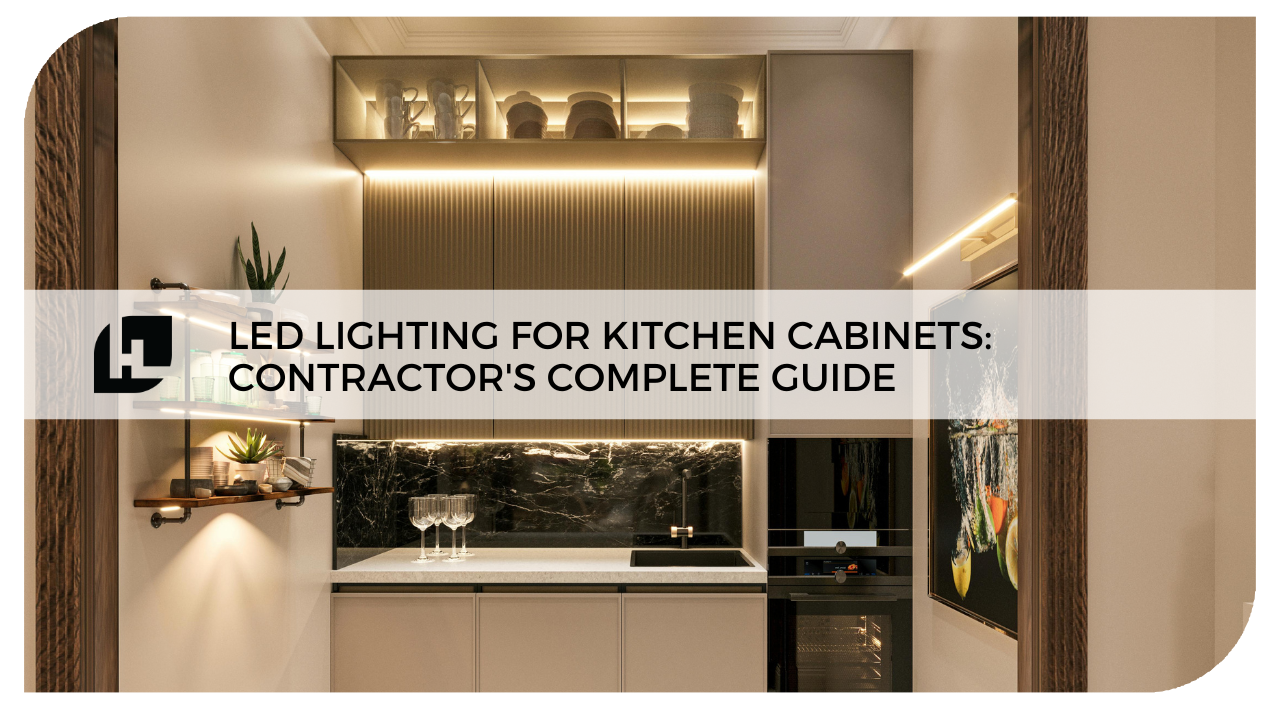
- Why Under-Cabinet LED Lighting Is Different From Other Installs
- Voltage: 24V Is the Professional Standard
- CRI: 90+ Is Non-Negotiable for Kitchens
- Color Temperature for Kitchens
- Strip Selection: COB vs High-Density
- Aluminum Channel Selection for Cabinets
- Dimming: Always Include It
- Power Supply Mounting
- Installation Checklist for Kitchen Cabinet Lighting
- Products for Kitchen Cabinet Lighting
Under-cabinet LED lighting is one of the most requested residential lighting upgrades. Done right, it transforms a kitchen and generates referrals. Done wrong, it's a callback waiting to happen. Here's how contractors and cabinet makers get it right.
Why Under-Cabinet LED Lighting Is Different From Other Installs
Under-cabinet lighting lives in a high-scrutiny environment. Homeowners use their kitchens daily, look directly at the underside of the cabinets, and notice every imperfection. Hotspots, color inconsistency, visible LED dots, and premature dimming are all complaints that come back to the installer.
The spec decisions you make before ordering material determine whether this job generates referrals or returns.
Voltage: 24V Is the Professional Standard
For kitchen cabinet lighting, 24V is the correct choice in almost every case. Runs often exceed 15 feet when you account for multiple cabinet sections, and 24V handles those distances without voltage drop. If the power supply is mounted inside a cabinet — the typical approach — wire runs from supply to first strip can add additional length. 24V handles that too.
12V works for very short single-cabinet runs (under 8 feet total), but for whole-kitchen installs, standardize on 24V.
CRI: 90+ Is Non-Negotiable for Kitchens
The kitchen is where CRI matters most in residential lighting. Food, countertops, backsplash tile, and wood cabinet finishes all look completely different under CRI 80 vs CRI 90+. A client who's just renovated their kitchen with $20,000 in custom cabinetry will notice immediately if the lighting makes their wood grain look flat.
Specify CRI 90+ for every kitchen cabinet installation. This is non-negotiable for any client who cares about the appearance of their kitchen — which is every client who's spending money on an upgrade.
Color Temperature for Kitchens
Warm white (2700K–3000K) is the most common choice for residential kitchen cabinets. It's compatible with most kitchen aesthetics and feels natural and inviting. Neutral white (3500K–4000K) works better in contemporary or commercial kitchens where a crisper, brighter look is preferred.
Avoid cool white (5000K+) under kitchen cabinets — it reads as harsh and clinical in most residential settings.
Strip Selection: COB vs High-Density
For kitchen cabinets, the two best options are COB strips and high-density strips, both in aluminum channels with frosted diffuser lenses.
COB strips produce the smoothest light line with no visible LED dots at any distance. They're the premium choice for exposed installations where the channel and diffuser are visible when cabinet doors are open.
High-density strips (120+ LEDs/meter) with a quality diffuser lens produce comparable results at a lower material cost. For most residential kitchens, high-density strips in aluminum channels deliver a professional result at a competitive price.
Never install bare strip tape directly to the cabinet underside without a channel and diffuser. The visible LED dots at close range are immediately noticeable and look unprofessional.
Aluminum Channel Selection for Cabinets
For under-cabinet kitchen applications, use slim surface-mount or slim recessed channels depending on the cabinet construction:
- Slim surface-mount (15mm width): Most common choice. Mounts to the cabinet underside with clips. The low 6mm profile is nearly invisible when installed correctly.
- Recessed (flush-mount): Routed into the cabinet bottom for a completely flush look. More labor-intensive to install but preferred on high-end custom cabinetry where nothing should be visible below the cabinet face.
Use channels with frosted diffuser lenses, not clear. Frosted diffusers scatter the light and eliminate visible LED hot spots through the lens.
Dimming: Always Include It
Every kitchen cabinet lighting installation should be dimmable. Period. Clients want to dim the under-cabinet lights for ambiance in the evening, and a non-dimmable install will generate a complaint the first time they try to use a dimmer switch.
Use a dimmable 24V driver rated for the total strip load plus 20% buffer, paired with a compatible dimmer. Common compatible protocols include TRIAC (most common for residential), 0–10V, and PWM. Confirm the dimmer protocol matches the driver before ordering.
Power Supply Mounting
The standard approach for kitchen cabinets is to mount the power supply inside one of the upper cabinets — typically the cabinet above the refrigerator, or the cabinet furthest from the primary viewing angle. Run a single power lead from the supply through a small drilled hole to the first strip, then daisy-chain or parallel-wire across the remaining strips.
Leave a service loop of a few inches at each connection point. Cabinet interiors get more work than you expect — a service loop makes future service possible without having to redo connections.
Installation Checklist for Kitchen Cabinet Lighting
- ✓ Voltage confirmed as 24V
- ✓ CRI 90+ specified
- ✓ Color temperature selected per client preference (typically 2700K–3000K)
- ✓ Strip type: COB or high-density with frosted diffuser channel
- ✓ Total run length measured, wattage calculated, driver sized at 120%
- ✓ Dimmable driver specified with compatible dimmer protocol
- ✓ Channels pre-cut and drilled for mounting clips
- ✓ Power supply location confirmed with service access
- ✓ All connections tested before final installation in channels
For help installing the strips inside the channels, see our step-by-step guide on how to connect LED strip lights.
Products for Kitchen Cabinet Lighting
- Single Color LED Strip Lights (CRI 90+ options available)
- Aluminum LED Channels
- Dimmable LED Drivers
- UL Listed LED Strip Lights
- Kitchen Lighting Collection
Updated July 2026 | HitLights — Factory-Direct LED Strip Lighting Since 2010